
For many years, the relationship between Bangladesh and the United States was shaped by aid, garments, and development support. That chapter is closing.
The new 2026 trade agreement between the two countries signals something different. It moves the relationship away from aid and toward a direct, business-driven partnership. In simple terms, Bangladesh gets access to the U.S. market and investment. In return, it agrees to align many of its rules and systems with American standards.
This is not just about tariffs. It is about how Bangladesh regulates medicine, technology, labor, food, energy, and even parts of its national security policy.
It is a big shift.
1. Faster Approval for U.S. Medicine
One of the most striking changes is in the health sector.
Under the deal, Bangladesh will accept U.S. FDA approval as enough evidence that a medicine or medical device is safe. That means American pharmaceutical and medical companies will not need to repeat local approval processes in most cases.
For patients in Bangladesh, this could mean faster access to new treatments and technology. For the Bangladeshi government, it means giving up some regulatory independence in exchange for speed and efficiency.
It is a trade-off. Faster access, but less control.
2. A Clear Path for U.S. Agricultural and Biotech Products
The agreement also affects food and farming.
Bangladesh agrees to treat the U.S. agricultural control system as equivalent to its own. Biotech crops that are approved in the U.S. will be allowed into Bangladesh without going through long, separate approval procedures.
Processed products like soybean meal or corn oil will not face extra biotech scrutiny. That makes it much easier for U.S. agricultural exports to enter Bangladesh.
Supporters will say this lowers food costs and improves supply stability. Critics will worry about long-term control over food standards. Both concerns are valid.
3. Protecting “Common Names” Like Cheddar and Salami
The agreement goes into surprising detail about food names.
Bangladesh agrees that common cheese and meat names such as Cheddar, Parmesan, Brie, Salami, and Prosciutto cannot be blocked due to European-style geographical protections.
This protects American producers from being shut out of the Bangladeshi market because of naming rules pushed by other trading partners.
It may sound small, but in global trade, product names matter a lot.
4. Digital Policy and Encryption Rules
The technology section may be one of the most important parts of the deal.
Bangladesh agrees not to force U.S. companies to hand over source code or create backdoor access to encrypted systems. It must also revise earlier digital rules that required traceability within encrypted services.
In addition, Bangladesh commits to opening up part of the 6GHz wireless spectrum for modern Wi-Fi technologies. This aligns its future wireless system with U.S.-backed standards.
This matters for telecom, cybersecurity, and the future digital economy. It signals that Bangladesh is choosing a specific technological path.
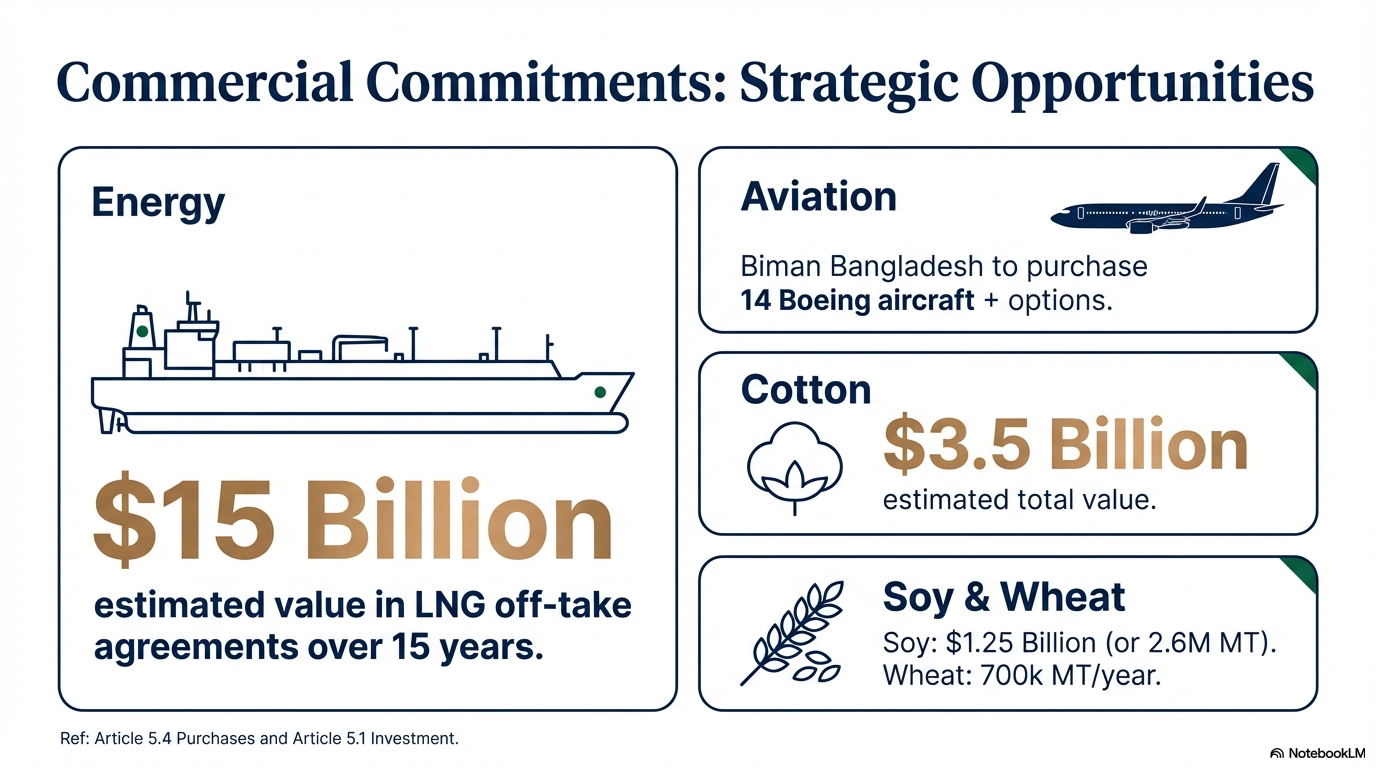
5. Big Commercial Commitments: Planes, Gas, and Grain
The agreement also includes very concrete economic commitments.
Bangladesh signals plans to:
- Purchase 14 Boeing aircraft, with options for more
- Buy around $15 billion worth of U.S. liquefied natural gas over 15 years
- Increase imports of U.S. wheat, soy, and cotton
These are not abstract promises. They shape long-term energy and infrastructure strategy.
There is also language encouraging Bangladesh to avoid buying certain nuclear materials or sensitive technology from countries that conflict with U.S. national interests.
That shows this deal is not just economic. It is geopolitical.
6. Labor Reform in the Garment Sector
For many Bangladeshis, the labor chapter may be the most meaningful.
The agreement requires reforms to the Bangladesh Labour Act. It pushes for easier union registration, stronger protection for collective bargaining, higher penalties for anti-union practices, and fewer restrictions on strikes.
It also bans goods made with forced labor, indentured labor, or child labor.
For garment workers, this could mean stronger rights and safer working conditions. Implementation will be key. Laws on paper are not enough. They must work in real life.
What Is Bangladesh Gaining?
This deal offers:
- More secure access to the U.S. market
- Long-term commercial partnerships
- Investment support
- Stronger labor protections
- Deeper integration into global supply chains
But it also requires:
- Alignment with U.S. regulatory standards
- Limits on certain policy choices
- Closer coordination on national security and technology
A Hard Choice, Not a Simple One
This agreement marks a turning point. Bangladesh is no longer treated primarily as an aid recipient. It is being treated as a strategic economic partner.
That sounds empowering, and in many ways it is.
But partnership comes with expectations.
The deeper question is this: How much regulatory independence is a country willing to trade for guaranteed access, stability, and geopolitical support?
Bangladesh has made a clear choice. It is tying its future growth more closely to the United States.
Whether that leads to stronger economic security and improved living standards will depend not just on the agreement itself, but on how carefully and fairly it is implemented in the years ahead.
History will not judge the text of the deal. It will judge the outcomes for workers, patients, farmers, and small businesses.
That is where the real story lies.
Detailed evaluation: https://youtu.be/__l61rhujmQ